


Disponible en Español 
Central Banks Communication Meeting
September 24 - 25, 2026
CEMLA Mexico City, Mexico
Hybrid format
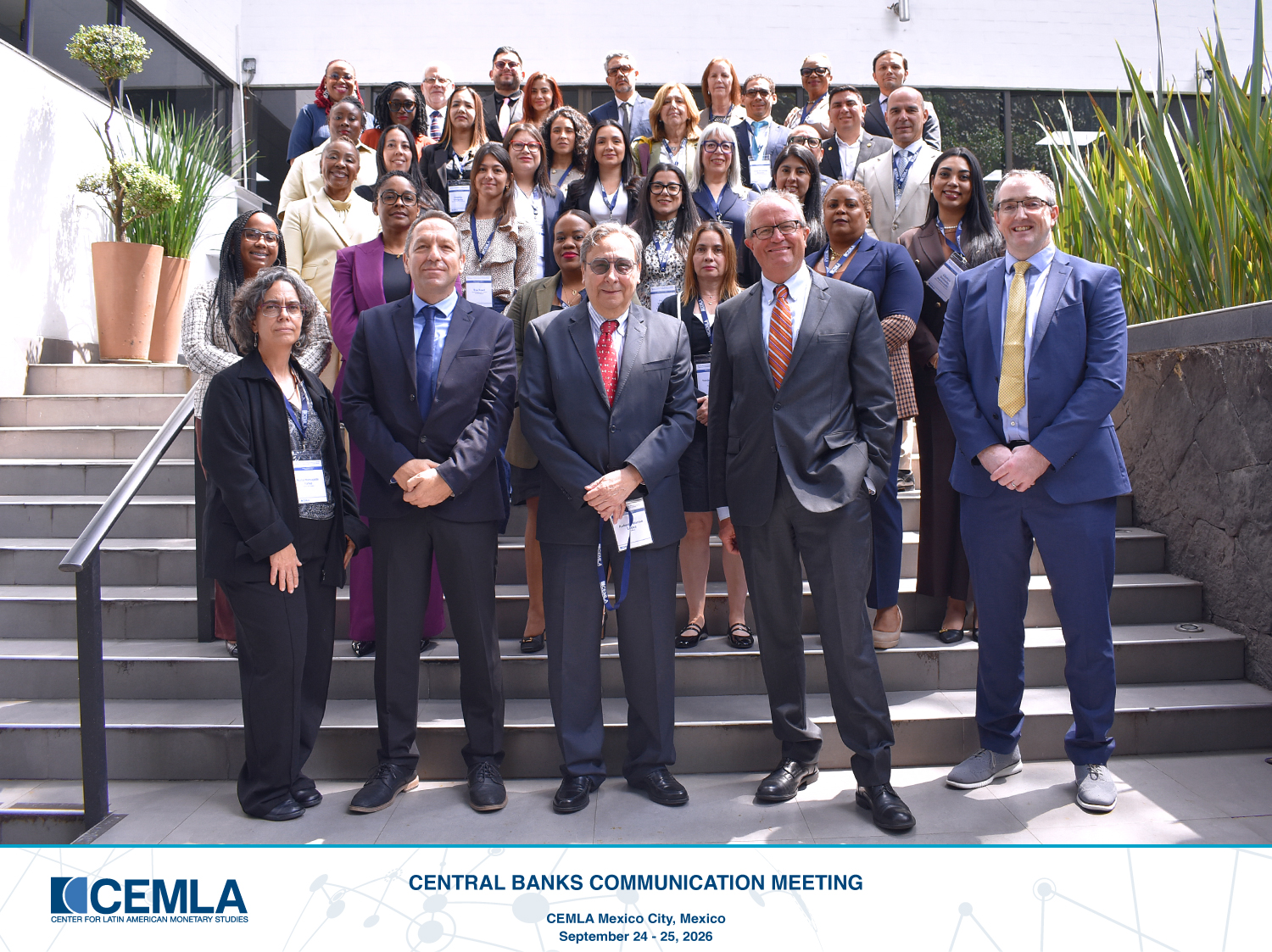
Central Bank Communications Meeting sponsored by the Center for Latin American Monetary Studies (CEMLA), held in Mexico City on September 24–25, 2026
Central Bank Communications Meeting
Official Opening and Welcome Remarks
Roberto Marino, Advisor to CEMLA’s General Directorate, and IMF representatives Tugrul Vehbi and Christoph Rosenberg of the IMF Institute for Capacity Development, who co-organized this Central Bank Communications Meeting with CEMLA, welcomed the participants.
They highlighted that it was gratifying to see a significant number of distinguished participants, experts in central bank communications, gathered at the Meeting, which demonstrates the great interest in this topic. They noted that 53 people participated, 36 in person and 17 virtually.
They commented that the topic of the Meeting is of paramount importance for understanding the functioning of modern central banking, particularly the important role played by communication and transparency in the effective conduct of monetary policy and the behavior of inflation.
They emphasized that monetary policy communication is defined as the process through which a central bank conveys information about its monetary policy objectives, strategies, and instruments, as well as its decisions and its current assessment of economic conditions and prospects.
They emphasized that monetary policy communication generally pursues two broad but interrelated objectives:
- increasing the effectiveness of monetary policy by influencing the expectations of financial markets, businesses, and households, and
- contributing to central bank accountability by improving transparency, credibility, and trust.
They commented that, over the past 20 years, central banks have learned a great deal about transparency and communication. During this time, they have increased their transparency with markets and opened up their relationship with the public. In general, they have adopted a more active approach to communication policy in order to strengthen the effectiveness of monetary policy.
They noted that this is important for several reasons.
First, accountability. Central bankers must be accountable for their actions. The public and legislators have the right to know what the central bank is doing to fulfill its mandate. Without public understanding of and support for independent central banks, there is a risk of losing public trust, and we know that trust is fundamental to the mission of central banks.
Second, monetary policy is more efficient and works better when economic agents and the public understand the central bank’s policy. It is very important that households’ inflation expectations remain anchored and aligned with the central bank’s inflation objectives so that low and sustainable inflation can be achieved.
They emphasized that advances in information technology over recent decades have accelerated the process of greater transparency and enabled better communication. These advances facilitate the real-time processing of large amounts of information, which has transformed the functioning of financial markets.
Faster and broader dissemination of economic data, central bankers’ statements, and observable patterns in monetary policy improve markets’ ability to monitor and predict central bank behavior.
They also commented that recent advances in machine learning and textual analysis enable better real-time analysis of central bank communications. Therefore, central bankers are now very careful in their choice of words in communications directed at financial markets. Communication is becoming an increasingly important tool for central banks to manage public expectations.
They emphasized that the last decade has witnessed profound changes in the way central banks communicate monetary policy, many of them implemented rapidly in response to urgent policy needs. Therefore, it is important to assess the evolution of these changes and determine which have been useful and which could benefit from modifications or improvements.
They noted that some of the main challenges in central bank communications are:
- Finding a balance between providing frequent and timely information to the private sector while, at the same time, limiting any potential noise and error.
- Communicating with more complex and controversial monetary policy tools and with an expanded central bank mandate.
- Avoiding leaks regarding central bank policies.
- Differentiating communication among different audiences.
- Improving central bank communication with the general public.
- Using social media as an effective communication channel.
- Finding ways to communicate diverse perspectives.
In conclusion, they commented that central banks face many communication problems and challenges. But the important point is that we are aware that good communication is essential to improving central bank accountability, preserving their independence, and making monetary policy more effective.
They emphasized that the first part of the Meeting would be led by IMF communications experts, who would discuss the importance of communication and communication challenges, and workshops on various topics related to central bank communications would be organized.
In the second part, the Meeting would begin with the keynote address by Dr. MacMahon, who would speak about recent changes and current challenges in central bank communications. Communications experts from various central banks would share their countries’ experiences. The speakers would explore the achievements and challenges faced by central banks in communications, based on reflection on their recent experiences and future perspectives.
Day 1
First session, Tugrul Vehbi, Senior Economist at the IMF, presented the paper entitled “Why Is Communication Important?” He highlighted the importance of understanding central banks’ communication methods, how communication has evolved over the years, whom communication should be directed to, and the role and design of forward-looking communication strategies.
Second session, Christoph Rosenberg, former Deputy Director, Communications Department, International Monetary Fund, asked participants: What are your communication challenges? Participants shared the challenges they face and agreed that communicating in simple, non-technical language is one of the main challenges.
Third session, Tugrul Vehbi, Senior Economist at the IMF, reviewed various central bank communications to identify whether there were any problems with that communication. He asked participants to identify problems in the communications.
Fourth session, Christoph Rosenberg, former Deputy Director, Communications Department, International Monetary Fund, gave a presentation on how to communicate in times of crisis. He discussed the stages of crisis communication, the best strategies, and presented several practical cases.
Fifth session, Michael McMahon, former Director of the Research Policy Network (RPN) at CEPR on central bank communications and Professor of Economics, University of Oxford, spoke about the challenges discussed during the day. He highlighted the importance of maintaining central bank credibility.
Day 2
First session, Michael McMahon, former Director of the Research Policy Network (RPN) at CEPR on central bank communications and Professor of Economics, University of Oxford, delivered the keynote lecture “Central Bank Communications: Recent Changes and Current Challenges.” His lecture addressed various aspects of central bank communications, such as forward guidance, the cost of sending the wrong message to the market, and communication under conditions of uncertainty. He mentioned that central banks must explain, engage, and educate the public in order to improve communication.
Second session, Christoph Rosenberg, former Deputy Director, Communications Department, International Monetary Fund, gave a presentation on the IMF’s communications policy. He emphasized that before 1993 the IMF operated with a high degree of secrecy. This policy changed radically following the Asian crisis. Today, the IMF promotes transparency both externally and internally, with the aim of strengthening confidence in the institution.
Third session, Gabriel Glöckler, Principal Adviser, Directorate General Communications, European Central Bank, presented the paper entitled “ECB Monetary Policy Communication in a Changing World.” He highlighted that communication is a major challenge for the ECB because it is a single central bank for 21 countries. He noted that artificial intelligence has accelerated the communications revolution.
Fourth session, Nuria Horcajada, Head of the Media Unit, Banco de España, presented a paper on the communications policy of Banco de España, entitled “A More Open, Accessible and Transparent Bank.” She highlighted all the actions being undertaken by Banco de España to make it a more open institution, closer to citizens. In particular, efforts to speak the audience’s language and to improve and adapt communication and listening channels.
Fifth session, Michel Moure, Manager of the Institutional Affairs Division, Banco Central de Chile, presented a paper on the Communications Policy of the Banco Central de Chile. He highlighted that the main challenges are: establishing meaning and purpose through a solid and coherent corporate narrative; maintaining a medium- and long-term perspective that allows for broader relationships with relevant stakeholders; continuously and in a segmented manner deploying actions through specific tools and platforms for each audience; and monitoring and measuring the effectiveness of the efforts undertaken.
Sixth session, Louise Egan, Director, Speeches and Policy Content, Communications Department, Bank of Canada, presented a paper on the Bank of Canada’s communications policy, entitled “Communicating Monetary Policy in Times of Inflation and Uncertainty: Lessons from the Bank of Canada.” She noted that effective communication consists of helping people understand what is important. She highlighted three lessons: first, establish a clear information hierarchy; transparency requires structure; second, communicate uncertainty with confidence; credibility depends on explaining uncertainty, not hiding it; third, integrate listening into the communication process, identifying which messages resonate and where gaps in understanding persist.
Final Remarks
Roberto Marino, Advisor to CEMLA’s General Directorate, closed the Meeting. He congratulated the speakers, participants, and CEMLA technical staff on the success of the Meeting. In particular, he congratulated the IMF representatives, Tugrul Vehbi and Christoph Rosenberg of the IMF Institute for Capacity Development, who co-organized this Central Bank Communications Meeting with CEMLA.
He highlighted that, during these days, a large group of experts presented and exchanged ideas, knowledge, and information on the latest developments in the field of central bank communications.
He emphasized that central bank communications face various technological and cultural challenges, that continuous training is required in this field, and that it should form part of the strategic vision of central banks.
He commented that artificial intelligence (AI) has the potential to significantly transform the operations of a central bank, improving efficiency and transparency. They considered that a clear strategy aligned with the institution’s mission and vision is essential to maximize the benefits of AI.
He concluded the Meeting by noting that central bank communications are challenging and that the exchange of views during these past few days showed that our institutions have the knowledge, tools, and, above all, the commitment to overcome these challenges. He also highlighted that there are numerous opportunities to improve communication processes.
He noted that during the Meeting it was possible to learn and strengthen collaborative ties that will surely extend beyond this event. He expressed his hope that we can create a network of support and shared knowledge, a community to which we can turn in the future to address new communication challenges in our institutions.
It was noted that the Central Bank Communications Meeting will be scheduled to take place every two years.
