


Disponible en Español 
CEMLA Course: DSGE Models for Central Banks
March 17 - 20, 2026
CEMLA Mexico City, Mexico
Face-to-face format
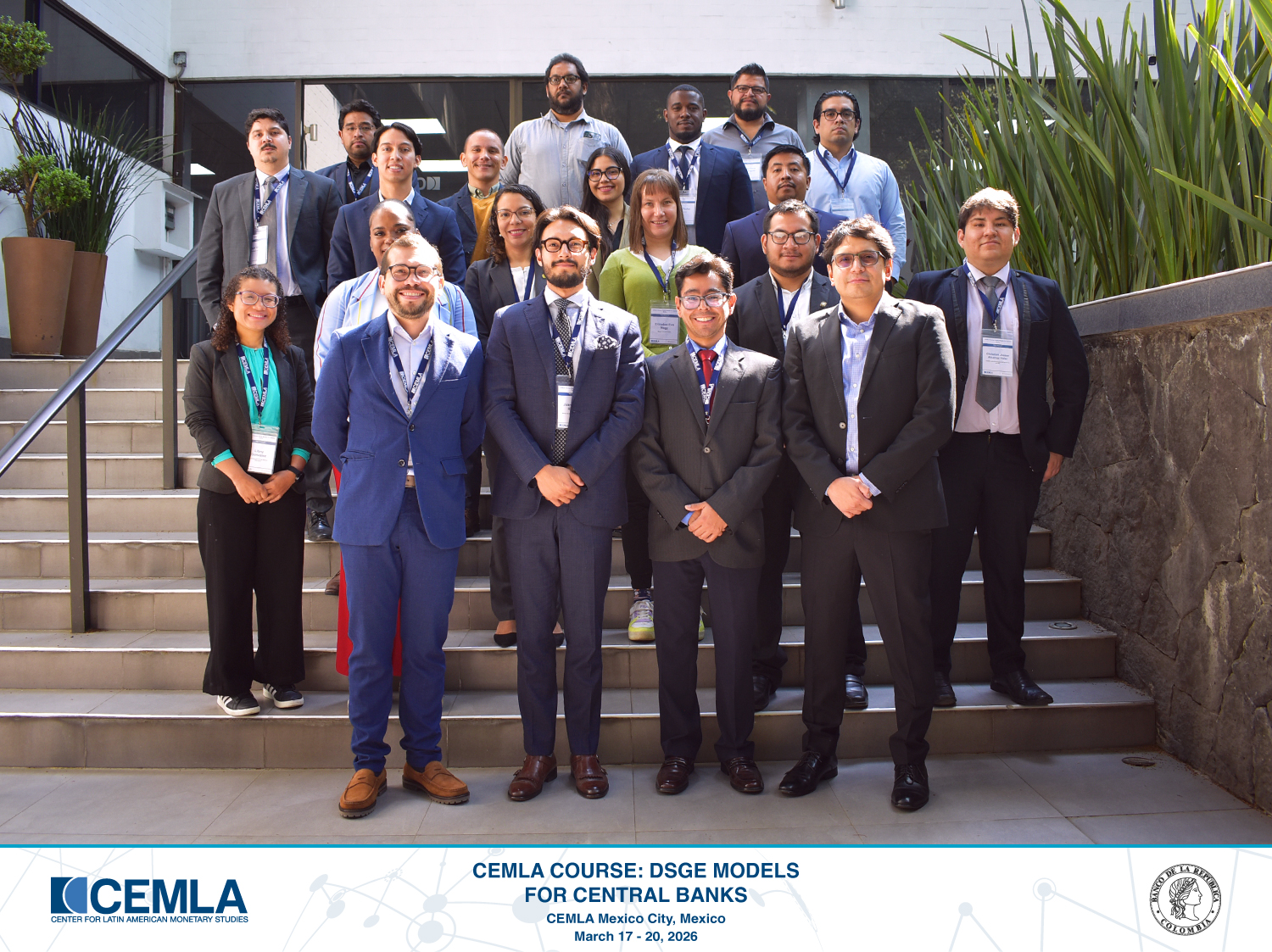
The DSGE Models for Central Banks course, held in a face-to-face format in Mexico City from March 17 to 20, 2026, offered a rigorous and applied introduction to Dynamic Stochastic General Equilibrium (DSGE) modeling for policy analysis and forecasting in small open economies. Aimed at analysts and economists in central banks, it combined economic theory with hands-on implementation using MATLAB, Dynare, and modern version-control tools. The course featured speakers from the Banco de la República of Colombia: Óscar Iván Ávila Montealegre, Fredy Castañeda, and Juan Andrés Rincón. Participants developed a baseline small open-economy DSGE model, learned to derive and calibrate steady states, and analyzed model dynamics through impulse responses and policy simulations within inflation-targeting monetary frameworks.
The course then advanced to model extensions relevant for policy work, including nominal and real rigidities, monetary policy rules, estimation methods (SMM, MLE, and Bayesian techniques), forecasting, and shock decomposition. Through an applied case study and a guided final project, participants gained end-to-end experience in building, estimating, validating, and interpreting DSGE models for their own institutional settings. The program concluded with a forward-looking discussion on recent developments in DSGE modeling, with a particular focus on TANK and HANK frameworks and their implications for monetary and fiscal policy analysis.