


Disponible en Español 
Meeting of Experts on Document Management, Archives, and Transparency in Central Banking
November 4 - 6, 2026
Madrid, Spain
Face-to-face format
Title: Managing Information to Strengthen Transparency, Knowledge, and Public Trust
Official Opening and Welcoming Remarks
Alberto Ríos, Director General for Institutional Relations, Transparency, and Branches at the Banco de España and Roberto Marino, Advisor to the Directorate General of CEMLA, welcomed participants to the Meeting of Experts on Records Management, Archives, and Transparency in Central Banking—an event titled "Managing Information to Strengthen Transparency, Knowledge, and Public Trust."
They noted that it was gratifying to see such a large number of distinguished participants—experts in records management, archives, and transparency within central banks—gathered for this meeting, which underscores the significant interest in the subject.
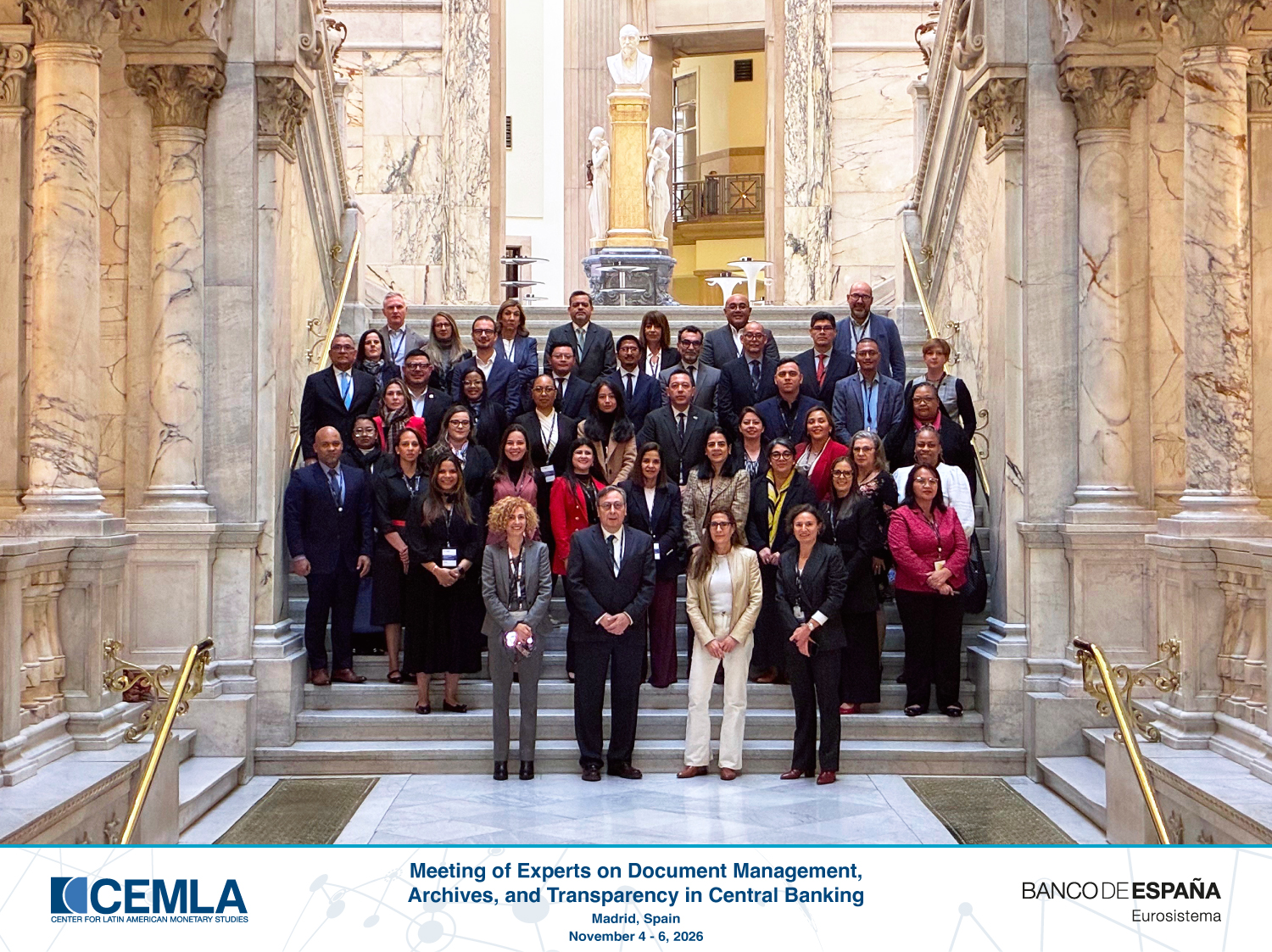
They highlighted the participation of 42 individuals representing various central banks and regional organizations (including FLAR, CEMLA, the Central American Monetary Council, and several banking superintendencies).
They remarked that the meeting’s theme is of paramount importance for understanding the functioning of modern central banking—specifically the vital role that transparency, access to information, and communication play in the effective conduct of monetary policy and the dynamics of inflation.
They affirmed that information that is better organized, preserved, and accessible helps central banks become more effective, more transparent, and more closely connected to society.
In an environment where information is highly valuable, the ability to manage records effectively is crucial to the success of monetary policies and to financial stability.
They highlighted that, in previous meetings, it has been noted that document management is essential for ensuring administrative efficiency, information security, and compliance with regulations. It has been acknowledged that there are numerous challenges stemming from technological transformation, but also many opportunities for improving processes. The use of artificial intelligence, talent diversification, and inter-institutional collaboration are key to progress.
It was noted that artificial intelligence (AI) has the potential to significantly transform the operations of a central bank, enhancing both efficiency and transparency. However, it was emphasized that a clear strategy—aligned with the institution’s mission and vision—is essential to maximizing the benefits of AI. AI-related development and training are crucial for driving innovation and cultural change within the organization. The adoption of AI must be secure, ethical, and human-centered, ensuring accountability and fairness.
Key applications of AI in central bank document management include:
- Automated classification and intelligent tagging.
- Text mining and economic research.
- Searching and managing accumulated knowledge.
- Data security, privacy, and anonymization.
- Preservation of historical archives.
It was also noted that, despite the gains in institutional efficiency, the use of AI does not replace the technical judgment of central bank specialists. Institutions require robust data governance frameworks to mitigate risks—such as algorithmic bias—ensure accountability, and maintain active transparency toward the public and regulated markets.
Regarding the role of artificial intelligence in central bank communication and transparency, it was pointed out that central bank communication has become a fundamental monetary policy tool for anchoring expectations, building credibility, and enhancing transparency.
It was highlighted that advancements in information technology over recent decades have accelerated the trend toward greater transparency and enabled more effective communication by central banks. Such advancements facilitate the real-time processing of vast amounts of information, which has undeniably transformed the functioning of financial markets.
Faster and broader dissemination of economic data, statements by central bankers, and observable patterns in monetary policies enhance the ability of markets to monitor and predict the behavior of central banks.
They emphasized that AI can be helpful in areas where central bank communication is key—such as ensuring that policy decisions are well understood and keeping inflation expectations anchored. They noted that AI enables the rapid analysis of large volumes of information from media outlets and market commentary. Furthermore, AI can assist in improving communication with the public.
They mentioned that the focus of this meeting will be on how to manage information to strengthen transparency, knowledge, and public trust. Topics to be addressed include information governance, digital preservation and transformation, artificial intelligence, the utilization and reuse of information, and the contributions of archives and libraries from the perspective of economic history. Discussions will also cover transparency, accountability, and institutional commitments within central banks.
They pointed out that all our institutions face similar challenges, such as the efficient management of documents, the preservation of critical information, and compliance with international regulations and standards. They encouraged participants to use this forum to learn from one another, to share how these challenges are being addressed, and to collectively identify innovative solutions that can be adapted to our own specific contexts.
It was noted that central banks have been working on document management initiatives for over 15 years, and that a key objective of this meeting is to assess the current needs and challenges central banks face regarding document management, archival practices, and transparency. Indeed, cybersecurity and information protection represent two major current and future challenges that central banks must address.
Regarding the management of archives, they remarked that central banks have a responsibility to maintain impeccable records, ensuring a lasting account of the institution’s activities across all its functions, its decision-making processes, and its organizational structure. Today, technology makes these archives far more accessible to citizens and researchers alike. They highlighted that the various initiatives undertaken by central banks to conserve, preserve, and disseminate their heritage—ranging from the use of institutional repositories to the creation of publications and exhibitions—will be addressed.
They expressed the hope that, over the coming days, we will be able to learn and forge collaborative ties that extend well beyond this event—that we might build a network of support and shared knowledge, a community where we can turn to one another in the future to address new challenges within our institutions and our professional practices.
Meeting Proceedings
Day 1. From Records Management to Information Governance.
Institutional Opening
Mr. Alberto Ríos, Director General for Institutional Relations, Transparency, and Branches, Banco de España.
Mr. Roberto Marino, Advisor to the Directorate General, CEMLA.
Opening Keynote. Information and Transparency: Levers for the Transformation of Central Banks. Ms. Ana Buisán, Director of the Transparency and Branches Department, Banco de España.
SESSION 1. Information Governance, Preservation, and Digital Transformation.
From Historical Archives to Information Governance: New Functions, New Professional Profiles, and Challenges. Ms. María de Inclán, Deputy Director of the Transparency and Branches Department, Banco de España.
Electronic Archives and Digital Preservation. Ms. Lola Mayo, Deputy Head of the Documentary Heritage and Information Services Division, Banco de España.
Records Management Governance, Archives, and Preservation. Mr. Filipe Fernandes, Coordinator of the Records Management Unit, Banco de Portugal.
Discussion and Q&A. Ms. María de Inclán, Ms. Lola Mayo, and Mr. Filipe Fernandes.
Are we witnessing an evolution of traditional archival and documentation services, or a fundamental shift in the model for managing information within central banks?
Transparency by Design: Information Management and Accountability to Strengthen Institutional Trust. Ms. Concepción Campos Acuña, President of the Council for Transparency and Good Governance, Ministry for Digital Transformation and the Civil Service.
Case Studies: Banco de España
Automation of Documentary Processes – Three Real-World Examples: Integrating 'Cosmos' with Collaboration Tools; Integrating Robots into 'Cosmos'; and Digital Signatures within 'Cosmos'. Ms. Marta Jiménez, Mr. José Ignacio Guerrero, and Mr. David del Vado, Documentary Heritage and Information Services Division, Banco de España.
Short Presentations
Documentary Modernization Project: Ms. Nancy Uriarte, Analyst III at the Banco Central del Uruguay.
New website and new communications manager: Sandra González, Executive in the Quality Management Department at the Banco Central de Costa Rica.
ERMES: User-Centric by Design, User-Friendly by Experience – The Bank of Italy's New Enterprise Document Management System: Emilia Patete, Senior Advisor at the Banca d´Italia.
Experiences in Document Management and Archiving: Liliana Ballén, Document Management Coordinator at the Central Bank of Colombia (Banco de la República).
Information Management That Connects: Érika Amaya, Information Management Specialist at the Latin American Reserve Fund (FLAR).
Day 2. Artificial Intelligence, Knowledge, and Information Reuse.
SESSION 2. AI and Information Management.
AI Presentations
Institutional Knowledge and Trust: Opportunities and Risks for Central Banks – Ignasi Belda, Director of the Department of Experimentation and Applied Technology Laboratory (DELTA) at the Banco de España.
AI Case Studies: The AI Context at the Bank of Spain – Ana Calleja, Deputy Division Head of Documentary Heritage and Information Services at the Banco de España.
Hackathon (Methodology and Ideas): Lola Mayo, Deputy Division Head of Documentary Heritage and Information Services at the Banco de España.
Cosme / Aurelia: José Ignacio Guerrero, Documentary Heritage and Information Services Division at the Banco de España.
Conversational Assistant: Marta Jiménez, Documentary Heritage and Information Services Division at the Banco de España.
VERA (AI Assistant for messages within Bank of Spain publications): Joaquín Selgas, Head of the Publications and Evaluation Division at the Banco de España.
SESSION 3. Economic History: The Contribution of Archives and Libraries.
Presentation: Economic History Project—Central Bank Archives and Libraries as Sources for Understanding Monetary, Financial, and Exchange Rate Policy. Dr. Juan Flores, professor in the Department of History, Economy and Society at the University of Geneva.
Case study. Reuse of historical sources, mass digitization, and historical data for economic research. Pilar Nogués-Marco, History, Economy, and Society, University of Geneva. Digitization projects at the Historical Archive of the Banco de España.
Digitization projects at the Historical Archive of the Bank of Spain. Raquel Jiménez, Documentary Heritage and Information Services Division, Banco de España.
Roundtable. Preserving, interpreting, explaining: from archives to artificial intelligence in the construction of economic knowledge. Ana Calleja, Juan Flores, Pilar Nogués, and Raquel Jiménez.
Presentation on the cataloging and identification of coins in the Bank of Spain collection. Patricia Alonso, Documentary Heritage and Information Services Division, Banco de España.
Day 3. Transparency and accountability: from institutional information to public trust.
SESSION 4. Transparency in action: challenges of transparency in central banking.
Presentation. Transparency and accountability as strategic pillars of a central bank. Marisa Boronat, Head of the Transparency Division, Banco de España.
Case studies. Transparency as a driver of change.
Sustainability—transparency as a material issue in central banking: from accountability to the creation of public value. Jorge Monge, Director of Institutional Relations, Banco Central de Costa Rica.
Projects aimed at strengthening institutional transparency. Sergio Zambrano, Transparency Management Manager, Banco Central de México.
Comparative study of best practices. Jordi Romeu, Expert, Transparency Division, Banco de España.
Restructuring of the Institutional Report. Lourdes Díaz-Barceló, Legal Counsel, Transparency Division, Banco de España.
Centralization of accountability requirements. Olga Celestino, Legal Counsel, Transparency Division, Banco de España.
Roundtable: From the Obligation to Publish to the Creation of Value.
Moderated by Marisa Boronat, Head of the Transparency Division, Banco de España.
Mª Dolores Cano Cayuela, Adviser, Data Office, Banco de España (Open Data).
Mª Cruz Manzano, Adviser, Transparency and Branches Department, Banco de España (Clear Communication).
Pilar Sahagún, Legal Counsel, Transparency Division, Banco de España (Transparency Portal).
Jorge Monge, Director of Institutional Relations, Banco Central de Costa Rica (Accountability).
César Cruz-Rubio, President of the Research Group on Government, Public Administration, and Public Policy (GIGAPP) (Open Government).
Marina Moya, Expert, Transparency Division, Banco de España (Focus Group).
Sharing session and closing session
Ten ideas for the modernization of documentation and transparency in central banking. Common challenges and opportunities for cooperation among central banks: AI, digital preservation, economic history, training, and transparency. Marisa Boronat, María de Inclán, Ana Calleja, and Roberto Marino.
Moderated by Ana Buisán, Director of the Transparency and Branches Department, Banco de España.
Closing remarks
María de Inclán, Deputy Director of the Transparency and Branches Department at the Banco de España, and Roberto Marino, Adviser to the Directorate General of CEMLA, brought the meeting to a close. They highlighted the successful organization of the event and congratulated both the Bank of Spain and the Center for Latin American Monetary Studies (CEMLA).
They highlighted that, over the past three days, a large group of experts presented and exchanged ideas, knowledge, and information regarding the latest developments in the fields of records management, archiving, and transparency, with the goal of sharing key projects and initiatives for the transformation and modernization of central banks.
They emphasized that records management faces various technological and cultural challenges, that continuous training in this field is required, and that it must form part of the strategic vision of central banks.
It was noted that artificial intelligence (AI) has the potential to significantly transform the operations of a central bank, enhancing both efficiency and transparency. It was considered essential to have a clear strategy—aligned with the institution’s mission and vision—to maximize the benefits of AI.
Development and training in AI are crucial for driving innovation and cultural change within the organization. The adoption of AI must be secure, ethical, and human-centered, ensuring accountability and fairness.
The meeting concluded with the observation that the path forward for document and records management in central banks is challenging; however, the exchange of views over the past few days demonstrated that our institutions possess the knowledge, the tools, and, above all, the commitment to overcome these challenges. Furthermore, it was highlighted that there are numerous opportunities to improve processes.
It was announced that the next meeting on document management, records handling, and transparency for central banks will be held in 2027, at a location yet to be determined.
