


Disponible en Español 
Meeting of Experts in Document Management and Central Banking Archives
November 26 - 28, 2025
Cartagena, Colombia
Face-to-face format
Meeting of Experts in Document and Archive Management in Central Banks, “New Horizons of Document Management in Central Banks”
Official opening and welcome speech.
Adalgisa Abdala Barcenas, General Director, Banco de la República (Colombia) and Roberto Marino, Advisor to the General Directorate of CEMLA welcomed the Meeting of Experts in Document and Archive Management in Central Banks, entitled “New Horizons of Document Management in Central Banks”.
They highlighted that it is gratifying to see a significant number of distinguished participants gathered at this Meeting, experts in the field of document management and archives in central banks, which demonstrates the great interest in the subject.
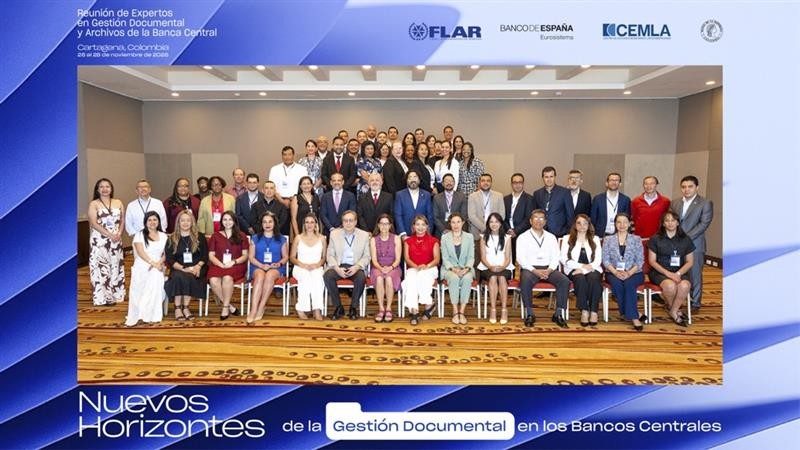
They noted that 39 people are participating, representing 14 central banks and several regional organizations (FLAR, CEMLA, Central American Monetary Council and Banking Superintendencies).
They commented that the topic of the Meeting is of paramount importance to understand the functioning of modern central banking, especially the important role that transparency, access to information and communication play in the effective conduct of monetary policy and the behavior of inflation.
They emphasized that central bank document management refers to the process of administering, organizing, controlling, and preserving all documents and records generated or received by the central bank in the course of its operations. These documents are crucial for daily operations, decision-making, and compliance with legal, regulatory, and operational requirements.
They stressed that intelligent and collaborative document management is required, utilizing all available tools.
They considered that proper document management in central banking generates many benefits.
Operational efficiency. A well-implemented document management system streamlines access to and retrieval of relevant information, reducing the time and costs associated with document management.
Regulatory compliance. Facilitates compliance with laws and regulations related to document preservation and information protection.
Security. Improves the protection of sensitive information and reduces the risks of loss or unauthorized access.
Transparency and accountability. It allows for more effective and transparent audits, which is essential for an institution like a central bank, which must be accountable to both government authorities and the public.
In summary, document management in central banking is essential to ensure the proper administration of information, security, and regulatory compliance, which has a direct impact on the operational efficiency and transparency of the institution.
They mentioned that this meeting will address the new horizons of document management in central banks, the issue of transparency and access to information, recent advances in document management, and what are considered best practices in this field. In this regard, the efficient and secure management of information, archiving processes and services, the challenges of digital transformation, the integration of new digital services and their connection to information management, and the evolution of robotics and process automation, among other topics, will be presented and discussed.
They pointed out that we all face similar challenges in our institutions: efficient document management, preservation of critical information, compliance with international regulations and standards, among others. They urged us to use this opportunity to learn from one another, to understand how we are addressing these challenges, and to identify innovative solutions together that we can adapt to our own contexts.
They noted that central banks have been working on document management initiatives for over 15 years and that a key objective of the meeting is to assess the current needs and challenges of central banks in terms of document management and records handling. Cybersecurity and information protection are certainly two of the major current and future challenges that central banks must address.
Regarding records management, they commented that central banks have the responsibility to maintain impeccable archives to document the central bank's activities across all areas of the institution, its decision-making processes, and its organization. Currently, technology makes these archives much more accessible to citizens and researchers. They emphasized that the various initiatives central banks are undertaking to conserve, preserve, and disseminate their records will be addressed, ranging from the use of institutional repositories to the production of publications and exhibitions.
They expressed their hope that in the coming days they could learn and strengthen collaborative ties that extend beyond this event. They hoped to create a network of support and shared knowledge, a community where they could turn to one another in the future to face new challenges in their institutions and practices.
Day 1: A journey through experience: Lessons that inspire, challenges that transform
First session, Inaugural Conference “New Horizons of Document Management in Central Banks”, by Adalgisa Abdala Barcenas, General Director, Banco de la República (Colombia).
In the second session, Ana Buisán, Director of the Transparency and Communication Department of the Banco de España, presented the paper entitled “Reinforced transparency: the commitment of the Bank of Spain to the citizens”.
The third session, focused on the “Integration of new digital services - connection with information management”, led by Luis Miguel Rodriguez Gutierrez Cárdenas, Project Manager, Citizen Service System Digital Citizen Services, Banco de la República (Colombia).
Fourth session, the topic addressed was “Transparency and access to information: A look and balance of the progress of the countries in Iberoamerica”, presentation by Carlos Alberto Zapata Cárdenas, Former Director, Archivo General de la Nación (Colombia).
In the fifth session, María Loreto de Inclán Sanchez, from the Transparency and Communication Department of the Banco de España, presented the paper “360° Documentary Services: From the Office to the Citizen”.
Sixth session, “Preserving to endure: Document planning with a vision for the future”, presented by Héctor Manuel Alvarado, Director of the Document Management Department, Banco de la República, Colombia.
Seventh session, “Purposeful Conclusions: Experiences, Challenges and Shared Future”, presented by Carlos Alberto Zapata Cárdenas, Colombia, Maria Loreto De Inclán, Spain, Héctor Manuel Alvarado, Colombia.
Day 2: New horizons and trends
First session, “Concepts, global trends in Artificial Intelligence”, presentation given by Antonio Candia, Fondo Latinoamericano de Reservas (Colombia).
Second session, “Use of new technologies in document management (Challenges in the integration of technological tools)”, led by German Torres Hernandez, Senior Consultant , Vilt Group (Colombia – Spain).
Third session, “From Theory to Practice: Successful Case of Artificial Intelligence in Document Management”, presented by representatives of Iron Mountain (Colombia).
Fourth session, “Design and construction of Archival Instruments for Hyper automation”, presented by Jhon Alexander Gonzalez, Project Management of Electronic Documents at Grupo IB Consulting SAS (Colombia).
The fifth session, “Dialogues with Experts: A Space for Exchange,” covered the following topics: New Technologies – German Torres Hernandez, Antonio Cania, Hector Alvarado, and Angelica Lopez; Artificial Intelligence – Iron Mountain, Fredy Vargas, Edwin Gonzalez, and Felix Velandia; Alexandra Celis and Alahidy Ramirez; and Archival Instruments from a Hyper automation Perspective – Jhon Gonzalez, Liliana Ballen, and Sandra Acosta.
Sixth session, “Intelligent Document Management: Digital transformation of the contractual file - Success story and lessons learned” by Liliana Ballen Millan, Specialized Professional, Banco de la República (Colombia).
Seventh session, “Intelligent transformation of knowledge: AI and strategic document management in Central Banks”, presented by Fredy Vargas Lama, Senior Consultant ECLAC/United Nations – Peru.
Day 3: Memory, challenges and direction: A Closing to Build the Future
First session, “From kilos to kilometers: Discipline, Data and Documents in motion”, presented by Sergio Humberto Gomez Torres, Consultant – Marathoner, Colombia.
Second session, “Online dissemination of documents from the Historical Archive of the Bank of the Republic”, led by Jose David Hernandez, Head of the Documentary Memory Section, Banco de la República, Colombia.
Third session, “Organizational Experience in Strategic Information Management: The Role of Digital Repositories”, presented by Erika Amaya Burgos, Information Management Specialist of the Fondo Latinoamericano de Reservas (FLAR).
Fourth session, “Project for the migration of documentation from legacy document management systems”, led by Baltasar Cordeiro, Area Coordinator, Banco de Portugal.
Fifth session, “Memory, challenges and direction: A Closure to Build the Future”, Roberto Marino López, CEMLA, Adalgisa Abdala Barcenas – Colombia.
Final comments
Adalgisa Abdala Barcenas, General Director of the Banco de la República of Colombia, and Roberto Marino, Advisor to the General Director of CEMLA, closed the meeting. They highlighted the successful organization of the event and congratulated the Bank of the Republic, the Center for Latin American Monetary Studies, the Banco de España, and FLAR.
They highlighted that, during these last three days, a large group of experts presented and exchanged ideas, knowledge and information on the latest advances in the field of document and archive management, with the aim of sharing key projects and initiatives for the transformation and modernization of central banks.
They emphasized that document management faces several technological and cultural challenges, that continuous training is required in this field, and that it should be part of the strategic vision of central banks.
They commented that artificial intelligence (AI) has the potential to significantly transform central bank operations, improving efficiency and transparency. They considered a clear strategy, aligned with the institution's mission and vision, essential to maximizing the benefits of AI.
AI development and training are crucial for leading innovation and cultural change within an organization. AI adoption must be safe, ethical, and people-centered, ensuring accountability and fairness.
The meeting concluded by noting that the path of document and records management in central banks is challenging, and that the exchange of views over the past few days demonstrated that our institutions have the knowledge, the tools, and, above all, the commitment to overcome these challenges. It was also highlighted that numerous opportunities exist for process improvement.
It was mentioned that the next Meeting on Document Management and Archives of Central Banks will be hosted by the Banco de España, in Madrid, Spain in 2026.
